Blog

The Fragmented Landscape of Digitisation
Industries today span a wide spectrum of digitisation maturity. Some still rely on handwritten receipts, attendance registers, and paper-based SOPs in their manufacturing floors. Others operate in hybrid environments—digitised in pockets but affected by data silos and format inconsistencies. A few have achieved full digitisation, adopting ETL pipelines and structured databases, yet still struggle with legacy instruments and formats like analog gauges or video-based data captures.
The challenge is how do we unify this fragmented data landscape into a consistent, compliant, and actionable format and how can AI help? And the answer lies in AI-powered ingestion and normalisation techniques.
The Digitisation Maturity Spectrum
You will find customers at different digitisation maturity levels. You may find them at different stages in their journey ranging from manual-first workflows to digitised and normalised data pipelines:
Manual-first : Handwritten receipts, registers, attendance registers with signatures and paper forms at factory floor & prescriptions at a Clinic.
Hybrid : Partial digitisation with disconnected / Siloed systems and formats. Here, part of the system is digitised and the paper based records/systems exist in pockets.
Digitised : Structured ETL pipelines, but legacy devices (possibly analog) still in play.
Normalized : AI ingests all formats and outputs consistent, schema-compliant data.
The Core Problem:
Heterogeneous Inputs, Inconsistent Outputs
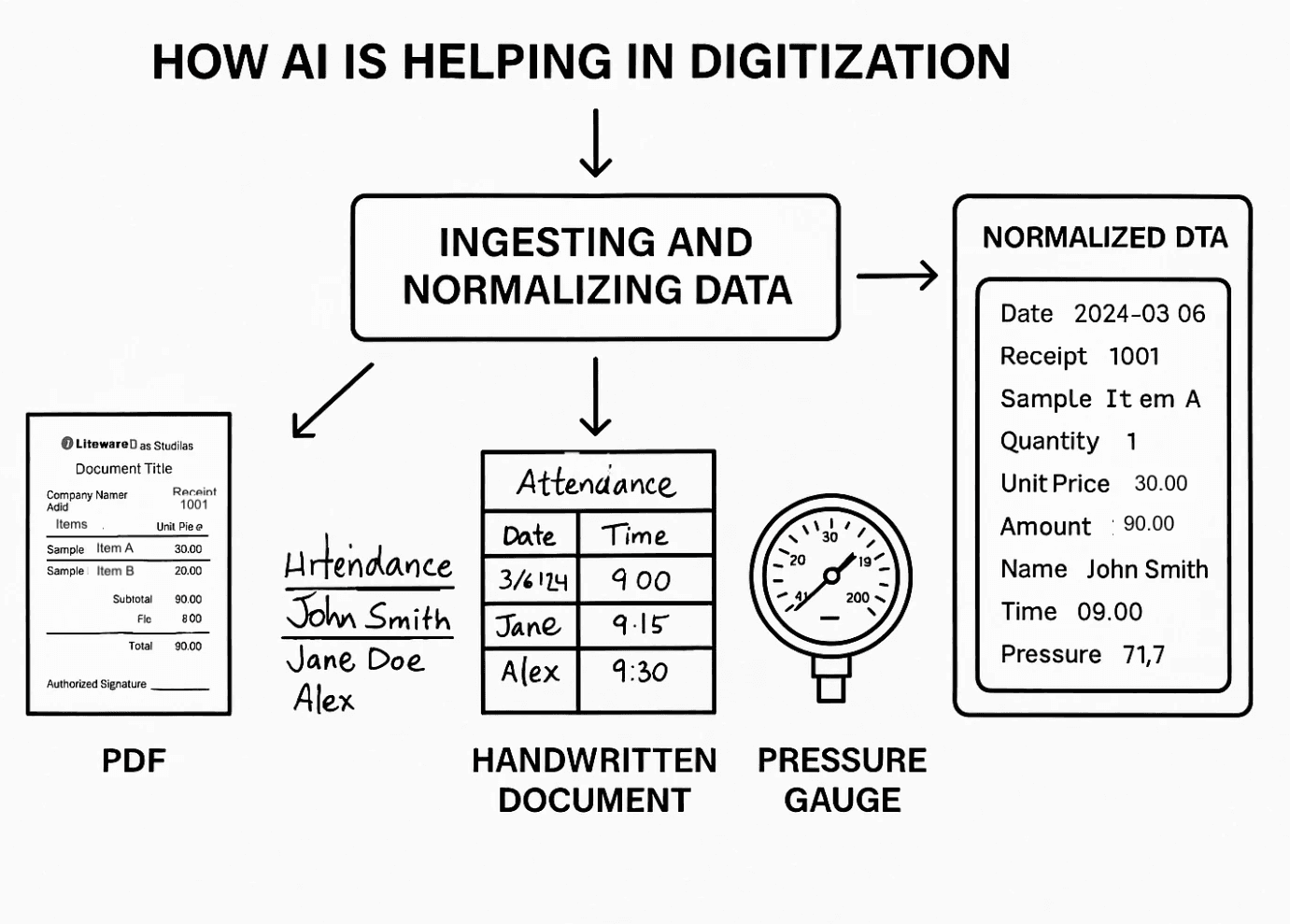
Data arrives in many forms:
Handwritten logs
Printed PDFs
Sensor readings from analog gauges
Video captures of instrument panels
Without a common schema, organizations face:
Inconsistent capture
Manual reconciliation
Loss of context
Huge Compliance risks
How AI Bridges the Gap
AI-Powered Document Ingestion
Transformer based models are everywhere, and using such models for OCR (Optical Character Recognition) and Layout-aware engines (e.g., Azure layout models, Gemini document layout models), AI can:
Extract text from printed receipts and handwritten documents
Detect headers, tables, and field orientation
Generate Python-based schemas for structured persistence
Example: Litewave Document Studio uses Transformer based OCR technique with layout models to classify fields, estimate data types, and produce audit-friendly templates.
Multi-Modal Data Integration
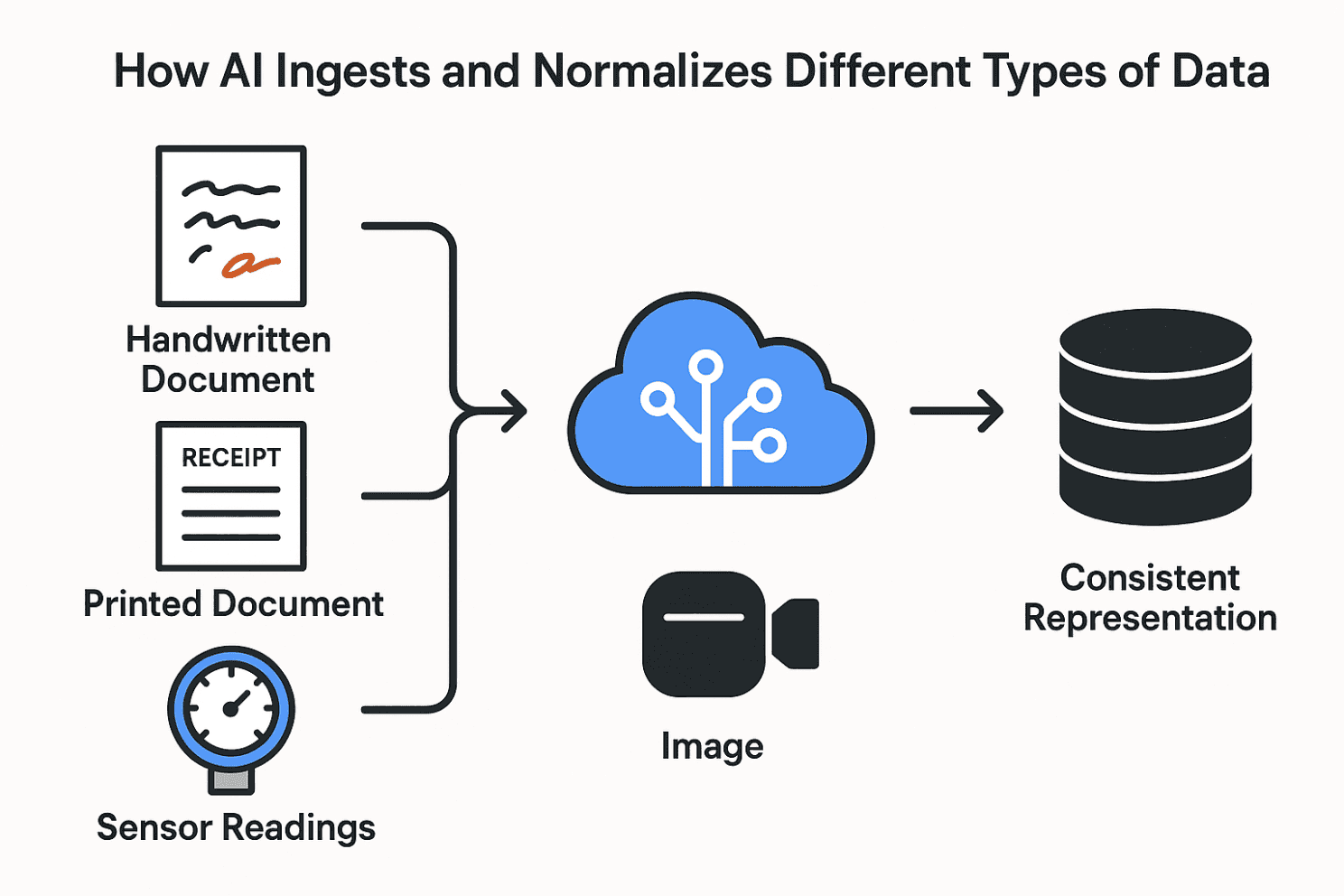
AI ingests:
Handwritten receipts → normalized text fields
Printed PDFs → structured tables
Sensor readings → numeric fields with validation ranges
Video captures → OCR on images → structured values
All unified into a common schema, enabling downstream analytics, compliance checks, and inferencing.
Confidence Scoring & Human-in-the-Loop Review
AI assigns confidence scores at both template and field levels:
Critical fields (e.g., signatures, identifiers) require ≥99% confidence
Low-confidence fields are routed to human reviewers
All corrections are logged in an audit trail
This ensures traceable accuracy and regulatory compliance, especially in life sciences, finance, and manufacturing.
Schema Normalisation
AI generates:
Flexible document schemas (e.g., Pydantic models) for unstructured inputs
Structured persistence schemas for SQL/ETL pipelines
This dual-layer approach allows rich capture without sacrificing consistency. Validation engines enforce data types, ranges, and referential integrity.
Generative Audit Reports: AI as a Compliance Partner
Beyond ingestion, AI can generate audit reports by:
Aggregating extracted data across documents
Highlighting anomalies (e.g., out-of-range values, missing signatures)
Summarizing human-in-the-loop interventions
Producing versioned, timestamped reports for regulatory submission
Example: In Litewave Document studio, AI tracks confidence scores, reviewer actions, and schema validations to produce a fully traceable audit report—ready for GMP, ISO, or CFR Part 11 compliance.
Conclusion - I consider AI as the Unifier of Digitization
AI doesn’t just digitise—it harmonizes. Whether your industry is manual-first or fully digitised, AI enables:
Consistent data representation
Compliance-ready workflows
Scalable integration of legacy and modern systems
The future is clear: AI will continue to bridge the gap between analog reality and digital resilience.